A Guest With Fur: How Cottage Nursing Weighs the Comfort of Pet Visits
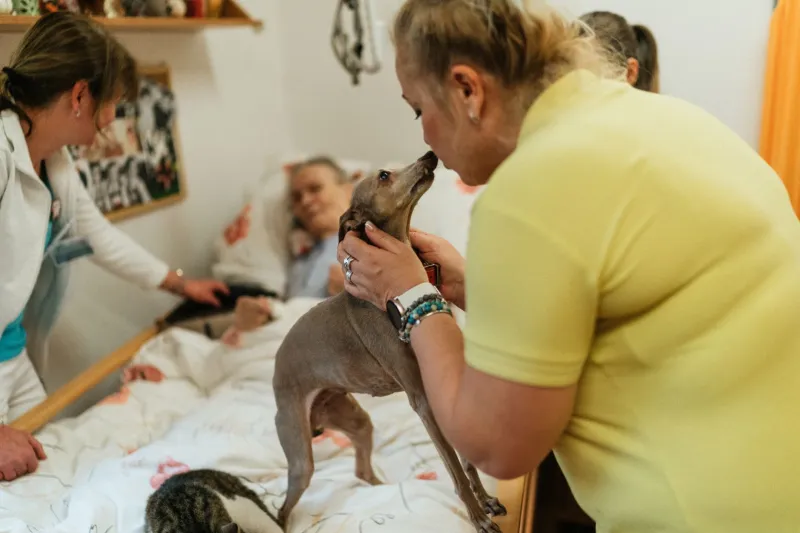
Pet visits in nursing care are sometimes discussed as though the only question is whether animals are allowed. In a cottage-style home, the more useful question is how they are allowed: with what preparation, for whom, and with what safeguards. A small setting can know its residents well enough to make that judgement individual rather than blanket. That is both its advantage and its responsibility.
The value of a familiar animal
For many older people, an animal is not a decorative extra. It is part of the texture of home. A dog on a lead in the hallway, a cat asleep in a sunny corner, or a supervised visit from a family pet can prompt conversation, movement and memory in ways that a planned activity sometimes cannot. The presence of an animal may lower the emotional temperature of a room. It can give a resident something to care for, however briefly, and a reason to sit forward rather than withdraw.
In cottage nursing, these moments are easier to arrange because the environment is domestic and the staff group is small. A registered therapy animal and its handler can be introduced calmly, without the noise and throughput of a larger institution. The visit can be timed around a resident's best hours, not a central timetable.
Comfort is not the same as contact
The benefits, however, are not universal. A resident who once kept dogs may now be frightened by them; a person with advanced dementia may misinterpret a sudden movement. Allergies and respiratory conditions must be taken seriously. Infection prevention is not an argument against animals, but it is an argument for planned visits: clean paws, controlled areas, hand hygiene and a clear route in and out.
The guiding principle is consent. A resident should be asked, in a way they can understand, whether they would like a visit. They should be able to decline without explanation, and to end the encounter without embarrassment. Families can help by knowing the resident's history and current preferences, and by not treating a pet visit as a treat that must be endured.
Questions to ask the home
Families considering a pet visit should ask the home for its policy in plain terms. Is the visit from a family pet, a registered therapy animal, or an assistance dog? Does the home require vaccination records, a risk assessment or a trial visit? Who supervises the animal, and who supervises the resident? What arrangements exist for residents with allergies, and how will the visit be kept away from communal food areas?
It is also reasonable to ask how the home records consent and how it reviews the visit afterwards. A cottage that can answer these questions without defensiveness is likely to be thinking about the whole resident, not just the pleasant photograph. In the UK, several organisations provide registered therapy animals, and assistance dogs have access rights that homes should understand. But most visits are simpler: a daughter bringing the family spaniel for half an hour. The same questions apply.
Preparing the animal
The animal carries responsibility too. A dog that jumps up, barks unpredictably or is anxious in unfamiliar rooms is not a good visitor, however affectionate at home. Before a visit, the animal should be groomed, exercised and settled. It should be comfortable on a lead and able to be moved away without a struggle. The handler should be someone the animal trusts and who can read its stress signals.
For cats and smaller animals, the calculus is different. Some residents gain great pleasure from a cat on a lap, but the visit must be short and the animal must have an escape route. The welfare of the animal matters as well as the welfare of the resident; a frightened animal is not a therapeutic tool.
Reading the encounter
The most important skill is observation. Comfort looks like leaning forward, reaching out, talking to the animal, or a settled silence. Overwhelm looks like turning away, stiffening, gripping the arms of a chair, or a change in breathing. In dementia, distress may appear as agitation or repeated questioning rather than a clear refusal. Staff should be ready to end the visit at the first sign, and families should not persuade a resident to continue for the sake of the animal or the occasion.
Short visits are usually better than long ones. A ten-minute encounter in a quiet lounge may achieve more than an hour in a busy room. The same animal should not be passed around a group as entertainment; each resident deserves an individual choice.
Afterwards
After the visit, hand hygiene and cleaning of surfaces should be routine. Staff may note whether the resident was calmer, more animated or more unsettled later in the day. That record helps the next visit. Families can also give feedback: what the resident enjoyed, what should be different, whether the animal should return.
A pet visit is not a substitute for good nursing care. It is a small, human-scale pleasure that a thoughtful cottage can offer when the conditions are right. The measure of success is not whether the animal was allowed through the door, but whether the resident was glad it came.